Inspection & Palpation
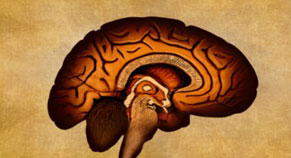 We are grateful to Dr. Arnold Lieber for the following narrative.
Paul is an old friend of mine, a 78 year old artist. When my wife and I saw him in the fall of last year we were shocked at the change that had come over him in a few months. He had a right facial, the eye lids drooping, mouth sagged open, saliva dripping. He also had more or less continuous severe pain in the area of the angle of the right jaw. He had seen a neurologist who diagnosed Bell's palsy and reassured him that recovery was likely. My wife (an internist) and I (a psychiatrist) exchanged looks and cautiously observed that it would be a good idea to work this problem up further, see another consultant, but we were not emphatic since we were reluctant to abruptly puncture the optimism of Paul and his wife Mary. "If it doesn't start getting better in the next week or two, you should see somebody".
Two cranial nerves involved. What could it be? It seemed ominous to us. I took out my old Grant's anatomy atlas and studied the brain stem and basal skull. In the weeks that followed, everything got worse, the right facial deepened and pain extended up to the forehead. I found a neurologist who specialized in cranial nerve disorders and neuro-opthalmology. Paul was disconcerted when he went to see him by his freely ventilated hostility directed at his medical assistant. He recommended a CT scan of the head and an LP. Both were unrevealing. Paul, put off by his bedside manner, didn't want to see him again. The radiologist who interpreted the CT scan was somehow in direct contact with the patient and recommended an exploratory operation to pursue the diagnosis and deaden the trigeminal nerve. Another consultant, Dr. G., a prominent ENT specialist, held out for making a diagnosis before intervening and recommended repeat studies. Time elapsed. Pain, poorly relieved by analgesics, continued. Paul had an episode of weakness and delirium, with hyponatremia, requiring hospitalization. Uncertainty and anxiety mounted. I noted that Paul had an abducens palsy as well. Finally Dr. G. scheduled an exploratory facial nerve operation.
A lawyer friend strongly urged Paul to see his friend, Dr. P, a head and neck surgeon at a New York medical center. I looked him up online and saw his impressive list of clinical papers. Maybe he could clarify the problem and how to deal with it. I went to the appointment with Paul and Mary.
In the examining room, a nurse took a rather cursory and inadequate history. "This visit isn't looking good," I thought. Dr. P. entered the room, a tall handsome gray-haired figure, with a calm, unhurried demeanor. His magisterial air reminded me of Arnold Steinhardt of the Guarneri Quartet. He sat close to Paul, took a meticulous detailed history. Some twenty years ago Paul was treated with a Mohs procedure for skin cancer on his face. Two years ago he had a similar lesion, which was excised without apparent recurrence.
Then he studied Paul's head and neck carefully, followed by a palpation of the afflicted area. He became interested in the right side of the neck and eventually demonstrated an induration of the greater auricular nerve. He left the room and returned in a few minutes with a cytologist who drew a tiny sample from the indurated nerve. Another pause. Dr. P. returned to the room and announced that the biopsy revealed squamous cell carcinoma, the clinical picture was one of retrograde infiltration of multiple cranial nerves, and that a course of treatment (radiation) would follow. (Dr. P. drew me aside for a moment and told me, "He's not going to make it.")
For me it was breathtaking. In the age of crowded waiting rooms, super-specialists, high tech procedures—in a single visit, a definitive diagnosis was made, mainly by physical examination—inspection…palpation.
What was the reaction of the patient and his wife to the experience, the diagnosis of invasive cancer? Relief and gratitude! "He touched me, he put his finger right on the problem," Paul declared.
Months later, Paul, an inveterate postcard-sender, sent us a postcard which read in part "Rob is the one who turned us on to Dr. P. who put his finger on my jaw where I'd been pointing to for three months and had been ignored by ten doctors who were competing to see who was the smartest doctor on the block. All duffed [sic] up. This doctor put his finger on the spot and pronounced it cancer, then had an associate come in and perform a needle biopsy which confirmed his prediction, So Rob saved my life as did you earlier (by suggesting further investigation)."
In the year that followed hope passed into resignation as the disease progressed. Paul died last month. He never revised his high opinion of his medical care.