Recent Study Analyzes Give-and-Take of Bedside Teaching
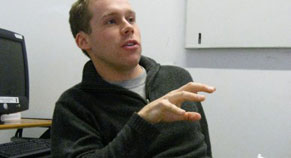
Dr. James Priest, University of Washington.
As a medical student at Stanford, Dr. James Priest was surprised by the different teaching styles he encountered during his internal medicine and pediatric clerkships. Surprised by the minimal amount of hard data on rounds, Dr. Priest decided to explore this difference before starting his pediatrics residency at the University of Washington. He collaborated with residency programs at Stanford and the University of Washington to observe rounds on pediatrics and internal medicine over a 10 month period in 2007-2008. The results of this study were recently published and illustrate the complex, and often unacknowledged, educational consequences unique to the inpatient culture of each specialty.
Dr. Priest and his collaborators found that pediatricians spent less time with patients than internal medicine physicians, and that less teaching on rounds is being conducted than in previous studies of internal medicine. Specifically, the percentage of rounds spent at the bedside on internal medicine was 37% in 2008 compared to 9-11% in the 1990's, while educational activities dropped from 22-29% in the 1990's to 9% in 2008. Perhaps most pertinently, the decrease in educational activities was accompanied by an increase in patient interactions; 8-12% in the 1990's to 25% in 2008.
As Dr. Priest remarked, "One might infer from these data that, on rounds at least, more time is now spent at the bedside interacting with patients instead of upon educational topics. The anti-correlation between education and time at the bedside could mean that, education on rounds occurred away from the bedside, and consequently may not be focused on physical diagnosis or inclusive of patient participation. As a pediatrician in training, our followup work aims better understand the attitudes that shape the inpatient trainee experience on rounds."